You were at a set. Or you found the recording after the fact: a 90-minute SoundCloud upload from a festival you attended last month. Somewhere around the 47-minute mark, the DJ dropped something and the room went sideways. You pulled out your phone and opened Shazam.
Nothing.
Maybe it spun for a few seconds and returned something vaguely similar. Maybe it timed out. Maybe it confidently named the wrong track. You tried SoundHound. Same result. You've been hunting for it since.
This is not a Shazam glitch. It's the wrong tool for the job.
Shazam solves a different problem
Shazam is genuinely excellent at what it was designed for: you hear a song on the radio, hold up your phone, it matches against a database of studio recordings and tells you exactly what's playing. The whole system is optimized around identifying one clean, isolated track at a time.
A DJ mix is not one track. It's 30, 50, sometimes 80 tracks played back-to-back over two, three, or four hours, each one transitioning into the next.
There are windows where Shazam would work, and windows where it won't, and you have no reliable way to know which moment you're in when you tap the button. But that's secondary to the bigger issue: the tool requires you to be present and manually invoke it, for every single track. The tool isn't broken. It was built for a different problem.
Why manual identification doesn't scale
Think through what it would actually take to use Shazam on a full two-hour DJ mix.
You'd need one attempt per track, timed to the window when the new track is cleanly playing and the previous one is fully gone. Miss that window, hit a blend, and Shazam won't match it. For a typical two-hour set, that's 20 or more attempts, with no misses allowed. Then you'd spend time filtering out the wrong results to figure out which ones are real.
For a full two hours. Without missing a single window.
Nobody actually does this. It's what you imagine doing before you think through what it would require.
How set79 identifies every track in a DJ mix
Paste a SoundCloud DJ mix URL and you get back a full timestamped tracklist: every identifiable track, with links to Spotify, YouTube, and Beatport. Most sets are ready in under 10 minutes.
The key is that set79 processes the entire mix from beginning to end automatically, track after track. You paste the URL, walk away, and come back to a complete tracklist. From there, each identified track opens its own page: streaming links, and every other DJ in the database who has played it, the starting point for real digging.
A few things that make the output trustworthy:
We leave gaps rather than guess. Transition moments, where two tracks are blending, are hard to identify reliably for any tool, including ours. Rather than pad your tracklist with wrong IDs, we leave those segments blank. A tracklist with honest gaps is more useful than one with three wrong tracks in it.
We also read the comments. Other listeners often name tracks in SoundCloud comments within hours of a set going live. We cross-reference those against the automated analysis, which catches things either source would miss alone.
900,000+ tracks identified across 40,000+ sets analyzed by set79, about 20 per set on average.
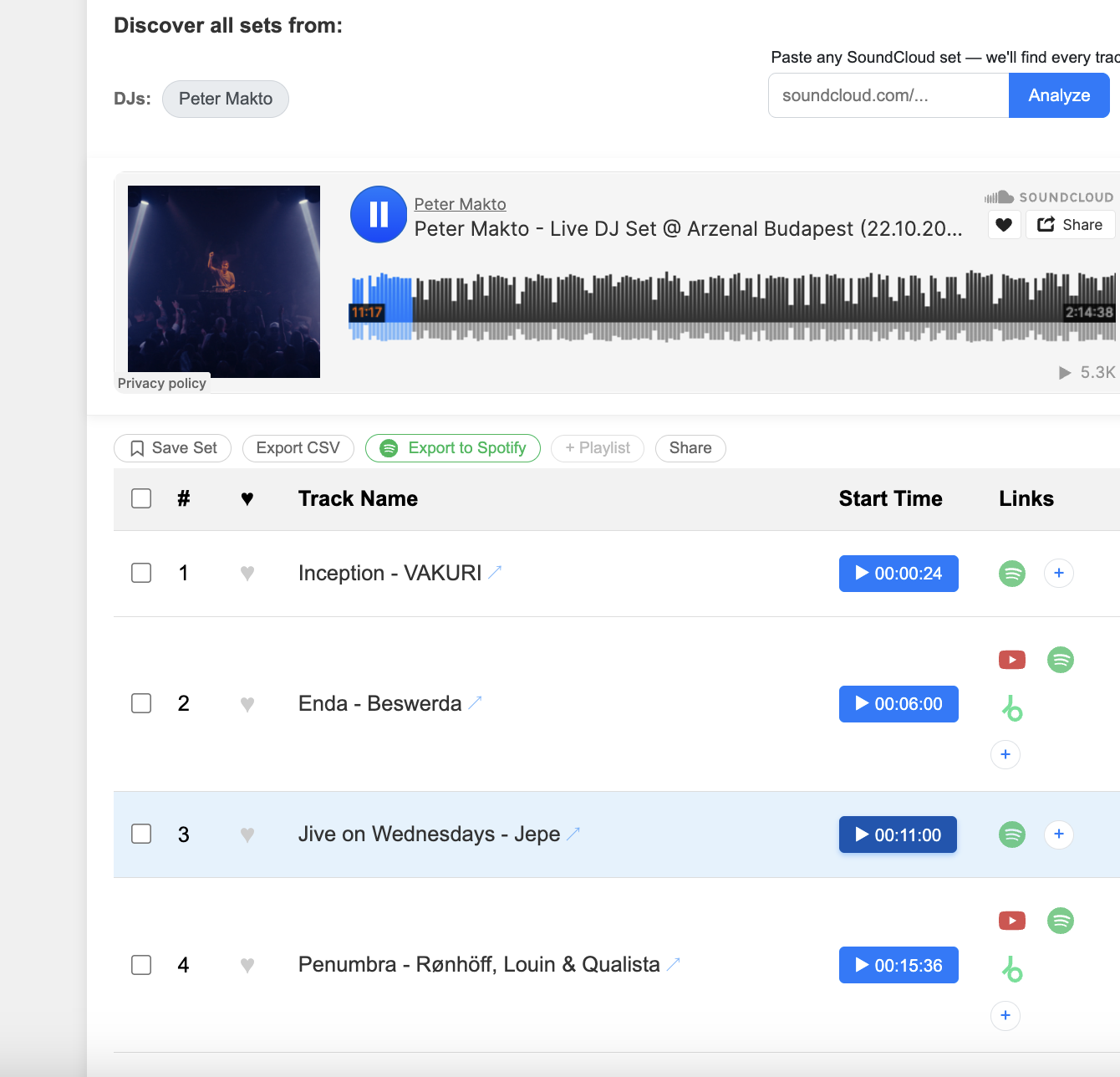
Here's a real example: a live set from Peter Makto at Arzenal Budapest, with 21 tracks identified and timestamped:
Why Reddit still catches things automated tools can't
r/EDM, r/DJs, and dozens of genre-specific subreddits have been manually solving track IDs for years. Someone will recognize an unreleased track from the piano line alone. Someone else attended that same festival and remembers what was playing at that moment. The community has institutional knowledge no automated tool has.
For tracks that genuinely can't be identified yet (DJ IDs that haven't released), posting to Reddit with a timestamp is the right next step. Someone who was there might recognize it from memory.
What are DJ IDs, and why some tracks can't be found yet
Some tracks can't be identified by any tool right now because they haven't been released yet.
DJs regularly play tracks before they're commercially available: promos, exclusives, tracks that won't exist in any database for months. The community calls these "IDs." If you've seen a DJ post a set recording and caption certain moments as "ID," that's what it means: the track's identity is unknown, not yet public.
If set79 can't identify a segment, we say so clearly. The gap in your tracklist is accurate information.
Once a track releases and enters the database, set79 notifies you automatically. You don't have to monitor anything manually. When the track becomes identifiable, you'll hear about it.
Following the artist on social media helps too. DJs almost always announce when a long-teased ID finally drops.
How the main options compare
Here's the side-by-side across what actually matters for a full DJ mix:
| Shazam | SoundHound | Reddit community | set79 | |
|---|---|---|---|---|
| Identifies tracks in a full DJ mix | No | No | Partially | Yes |
| Processes full set unattended | No | No | No | Yes |
| Timestamped tracklist output | No | No | No | Yes |
| Fully automated | One track at a time | One track at a time | No | Yes |
| Spotify / YouTube links | No | No | No | Yes |
| Reads SoundCloud comments | No | No | No | Yes |
| Notified when unreleased tracks drop | No | No | No | Yes |
| Free to try | Yes | Yes | Yes | Yes (7-day trial) |
Reddit is not really a competitor here: it fills in the gap for what no tool can solve yet: tracks that aren't in any database. The two work together, not against each other.
Frequently asked questions
Does Shazam work on DJ mixes?
Shazam works on individual tracks played cleanly and in isolation. You can use it on a DJ mix by opening it during clear sections of individual tracks, but this requires you to be present and manually time an attempt for every track: 20 or more for a typical two-hour set, with no guarantee you'll catch the clean window each time.
How do I find the songs in a DJ mix?
The most efficient method for a SoundCloud DJ mix is set79: paste the URL and get a full timestamped tracklist automatically. For tracks set79 can't identify (usually unreleased promos), the SoundCloud comments are often the next best resource. As a last step, posting a timestamp to r/EDM or r/DJs usually gets a response from someone who recognizes the track.
What is a DJ ID?
A DJ ID is an unreleased track: a song a DJ plays before it's commercially available. DJs often play IDs to test a track's reaction on a crowd, or because they have an exclusive before the official release. If a segment in your tracklist shows as unidentified, it's often because the track is a DJ ID and genuinely isn't in any database yet. Once the track releases, set79 can notify you.
How long does set79 take?
Most standard sets are processed in 7–10 minutes. Longer sets (3+ hours) take proportionally more time. Audio quality also matters: a live festival recording will typically have more gaps than a studio-quality SoundCloud upload.
That track you've been hunting since the 47-minute mark? Paste the set URL at set79.com. Most sets are done in under 10 minutes, and the first 7 days are free.